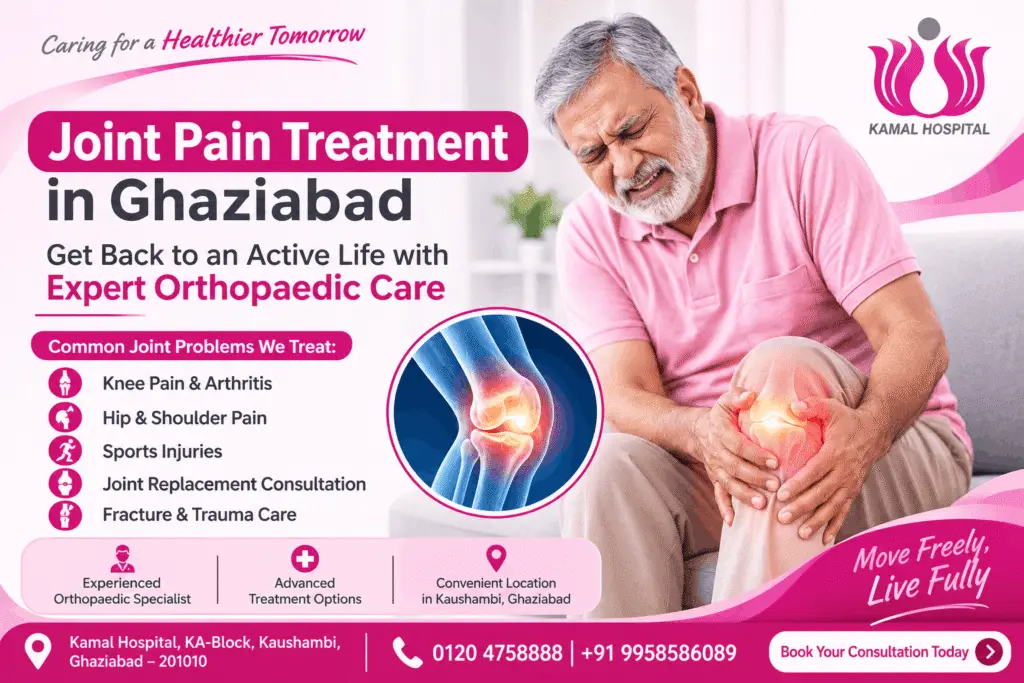
Are you experiencing knee pain while walking, stiffness in your joints after waking up, or difficulty climbing stairs? Joint pain is a common orthopaedic problem that can affect people of all age groups. If left untreated, persistent joint pain can interfere with everyday activities and reduce your quality of life.
Many people living in Ghaziabad, Kaushambi, Vaishali, Indirapuram, Vasundhara, and nearby areas of Delhi NCR experience joint-related problems due to ageing, arthritis, sports injuries, sedentary lifestyles, and other medical conditions.
Finding the right joint pain treatment in Ghaziabad starts with identifying the underlying cause. Depending on the condition, treatment may include medication, physiotherapy, lifestyle modifications, joint injections, or surgical procedures.
At Kamal Hospital, Kaushambi, Ghaziabad, patients can consult experienced orthopaedic specialist Dr. Tejbir Singh Arora, Consultant Trauma, Arthroscopic & Arthroplasty Surgeon, with over 26 years of experience in orthopaedic care.
Whether you are experiencing knee pain, hip pain, shoulder discomfort, arthritis symptoms, or mobility problems, timely orthopaedic consultation can help you understand your condition and explore suitable treatment options.
What Is Joint Pain?
Joint pain refers to discomfort, soreness, stiffness, or inflammation in the areas where two or more bones meet. Joints help the body move, bend, stretch, and perform everyday activities.
The human body has several important joints, including:
- Knee joints
- Hip joints
- Shoulder joints
- Elbow joints
- Wrist joints
- Ankle joints
- Finger joints
Healthy joints contain cartilage that helps reduce friction between bones during movement. Ligaments, tendons, muscles, and joint fluid also support joint stability and function.
When these structures become damaged, inflamed, or affected by disease, a person may experience pain, swelling, stiffness, and restricted movement.
Joint pain may develop suddenly following an injury or gradually due to conditions such as osteoarthritis, rheumatoid arthritis, or age-related joint changes.
What Are the Common Causes of Joint Pain?
Understanding the causes of joint pain is essential for selecting the right treatment. Different medical conditions can affect joints in different ways.
1. Osteoarthritis
Osteoarthritis is one of the most common causes of joint pain, especially among older adults. It develops when the protective cartilage covering the ends of bones gradually wears down.
As the condition progresses, patients may experience:
- Knee pain while walking
- Joint stiffness after resting
- Difficulty climbing stairs
- Swelling around affected joints
- Reduced flexibility and mobility
Osteoarthritis commonly affects the knees, hips, and hands.
2. Rheumatoid Arthritis
Rheumatoid arthritis is an autoimmune condition in which the immune system attacks the lining of the joints.
It can cause inflammation, swelling, pain, and prolonged morning stiffness. It may affect multiple joints, often on both sides of the body.
Early diagnosis and appropriate treatment are important to control inflammation and reduce the risk of joint damage.
3. Knee and Joint Injuries
Sports activities, road accidents, falls, and sudden movements can damage the structures supporting the joints.
Common injuries include:
- ACL and ligament injuries
- Meniscus tears
- Joint sprains
- Cartilage injuries
- Fractures around joints
- Tendon injuries
People experiencing persistent pain after an accident or sports injury should consult an orthopaedic specialist.
4. Excess Body Weight
Excess body weight increases pressure on weight-bearing joints, particularly the knees and hips.
Over time, additional stress may contribute to joint discomfort and increase the risk of osteoarthritis.
Maintaining a healthy body weight can help reduce pressure on joints and support better mobility.
5. Age-Related Joint Problems
As people grow older, changes in cartilage, muscles, bones, and joint structures can affect flexibility and movement.
Older adults may experience knee stiffness, hip discomfort, and difficulty walking.
However, persistent joint pain should not automatically be considered a normal part of ageing.
6. Gout and Joint Inflammation
Gout is a form of inflammatory arthritis caused by uric acid crystal accumulation in a joint.
It can cause sudden episodes of severe pain, redness, swelling, and tenderness. The big toe is commonly affected, although other joints can also be involved.
7. Sedentary Lifestyle and Repetitive Movements
Long hours of sitting, limited physical activity, poor posture, and repetitive movements may contribute to joint stiffness and discomfort.
People working desk jobs or performing physically demanding activities may experience pain in their shoulders, wrists, knees, and other joints.
What Are the Early Symptoms of Joint Pain?
Recognising the early warning signs of joint problems can help patients seek timely medical attention.
Common symptoms include:
- Pain during movement: Discomfort while walking, bending, climbing stairs, or lifting objects.
- Morning stiffness: Difficulty moving joints after waking up.
- Joint swelling: Visible swelling around the affected area.
- Redness and warmth: The skin around an inflamed joint may become warm or red.
- Reduced mobility: Difficulty bending, stretching, or moving the joint normally.
- Clicking or grinding sounds: Unusual sounds or sensations during joint movement.
- Muscle weakness: Reduced strength around the affected joint.
- Difficulty walking: Pain or discomfort while standing or walking.
If you experience recurring joint pain or increasing stiffness, consult an orthopaedic doctor for proper evaluation.
Which Joints Commonly Develop Pain?
Joint pain can affect different parts of the body. However, the knees, hips, shoulders, and hands are commonly affected.
1. Knee Joint Pain
Knee pain is one of the most common orthopaedic complaints in adults and older people.
It may develop due to osteoarthritis, ligament injuries, meniscus tears, or excessive pressure on the knee joint.
Common symptoms include pain while walking, difficulty climbing stairs, swelling, and stiffness.
2. Hip Joint Pain
Hip pain may develop due to arthritis, injuries, inflammation, or damage to the hip joint.
Patients may experience discomfort while walking, sitting, standing, or rotating the leg.
3. Shoulder Joint Pain
Shoulder pain may result from frozen shoulder, rotator cuff injuries, arthritis, or inflammation of surrounding tissues.
It can make lifting the arm, reaching overhead, and performing everyday activities difficult.
4. Wrist and Finger Joint Pain
Pain in the fingers and wrists may be associated with arthritis, repetitive movements, tendon problems, or previous injuries.
Swelling, stiffness, tenderness, and difficulty gripping objects are common symptoms.
How Is Joint Pain Diagnosed at an Orthopaedic Hospital in Ghaziabad?
Correct diagnosis is the first step towards effective joint pain management.
At Kamal Hospital, Kaushambi, an orthopaedic specialist may evaluate the patient’s symptoms, medical history, and physical condition before recommending appropriate investigations.
1. Physical Examination
The doctor may examine the affected joint to check:
- Pain and tenderness
- Swelling and inflammation
- Joint flexibility
- Range of motion
- Muscle strength
- Joint stability
2. X-Ray
An X-ray may help identify fractures, changes in joint spaces, bone abnormalities, and certain signs of arthritis.
3. MRI Scan
MRI may be recommended to examine soft tissues such as ligaments, tendons, cartilage, and the meniscus.
4. Blood Tests
Blood investigations may be advised if the doctor suspects rheumatoid arthritis, gout, infection, or another inflammatory condition.
5. Joint Fluid Analysis
In selected cases, a joint fluid sample may be examined to investigate gout or possible joint infection.
Not every patient requires all these investigations. The doctor decides which tests are appropriate based on the patient’s symptoms and examination findings.
Best Treatment for Joint Pain in Ghaziabad
The best treatment for joint pain depends on the underlying medical condition, severity of symptoms, age, lifestyle, and overall health of the patient.
At Kamal Hospital, Kaushambi, patients can seek orthopaedic consultation for joint pain, knee problems, sports injuries, arthritis, fractures, and other musculoskeletal conditions.
Treatment options may include the following:
1. Medication for Joint Pain
Doctors may prescribe suitable medicines to help manage pain, swelling, and inflammation.
Depending on the diagnosis, treatment may include:
- Pain-relieving medicines
- Anti-inflammatory medicines
- Topical pain-relief gels
- Condition-specific medicines for arthritis or gout
Always take medication according to medical advice. Certain medicines may not be suitable for patients with kidney disease, stomach ulcers, heart conditions, or other medical problems.
2. Physiotherapy and Joint Rehabilitation
Physiotherapy can play an important role in managing many joint conditions.
A personalised rehabilitation programme may include:
- Muscle-strengthening exercises
- Joint mobility exercises
- Stretching techniques
- Balance training
- Flexibility exercises
- Post-injury rehabilitation
Strengthening the muscles around affected joints can improve support, stability, and functional movement.
3. Lifestyle Changes and Weight Management
Lifestyle modifications can help reduce unnecessary pressure on joints.
Doctors may recommend maintaining a healthy weight, following an appropriate exercise routine, eating a balanced diet, and avoiding excessive strain on painful joints.
4. Joint Injections
In selected cases, joint injections may be considered to manage inflammation and discomfort.
The type of injection and its suitability depend on the patient’s diagnosis and medical condition.
5. Arthroscopic Surgery
Arthroscopy is a minimally invasive surgical procedure that uses a small camera and specialised instruments to examine and treat certain joint problems.
It may be recommended for selected conditions involving ligament injuries, meniscus tears, and other joint-related problems.
6. Knee and Hip Replacement Surgery
Joint replacement may be recommended when severe joint damage causes persistent pain and significantly affects daily activities, particularly when suitable non-surgical treatments have not provided sufficient relief.
Common procedures include:
- Total knee replacement
- Partial knee replacement in selected patients
- Total hip replacement
An orthopaedic surgeon evaluates the patient’s condition before recommending joint replacement surgery.
Why Choose Kamal Hospital for Joint Pain Treatment in Kaushambi, Ghaziabad?
Choosing the right hospital and orthopaedic specialist is important when dealing with persistent joint pain, arthritis, sports injuries, or mobility problems.
Kamal Hospital, Kaushambi, Ghaziabad, provides orthopaedic consultation and medical care for patients from Ghaziabad and nearby areas of Delhi NCR.
1. Experienced Orthopaedic Specialist
Consultant Trauma, Arthroscopic & Arthroplasty Surgeon
With over 26 years of experience, Dr. Tejbir Singh Arora specializes in orthopaedic care, trauma management, arthroscopic procedures, and joint replacement.
His areas of clinical expertise include:
- Knee and hip replacement
- Joint pain evaluation
- Arthritis management
- Arthroscopic knee and shoulder surgery
- Sports injury treatment
- ACL and ligament injuries
- Fracture and trauma management
2. Comprehensive Orthopaedic Care
Patients can seek consultation for various bone and joint problems, including knee pain, hip pain, shoulder problems, arthritis, fractures, sports injuries, and joint replacement evaluation.
3. Convenient Location in Kaushambi
Kamal Hospital is located in KA-Block, Kaushambi, Ghaziabad, Uttar Pradesh – 201010.
Its location makes it accessible to patients from nearby areas, including:
- Kaushambi
- Vaishali
- Indirapuram
- Vasundhara
- Sahibabad
- Anand Vihar
- East Delhi
- Ghaziabad
Patients from these locations can visit Kamal Hospital for orthopaedic consultation and treatment guidance.
4. Patient-Focused Treatment Approach
Every patient may have a different cause of joint pain. Treatment recommendations are based on individual symptoms, examination findings, medical history, and diagnostic reports.
The objective is to identify the underlying problem and recommend suitable treatment options.
7 Tips to Prevent Joint Pain and Maintain Healthy Joints
1. Maintain a Healthy Weight
Along with appropriate medical care, healthy everyday habits can support better joint function.
Excess body weight places additional pressure on the knees and hips. Maintaining a healthy weight may help reduce stress on these joints.
2. Exercise Regularly
Choose suitable low-impact activities such as walking, swimming, or cycling according to your physical condition.
3. Avoid Sitting for Long Hours
Take regular breaks from prolonged sitting and perform gentle movements to reduce stiffness.
4. Eat a Balanced Diet
Include fruits, vegetables, whole grains, pulses, dairy products, nuts, and adequate protein in your daily diet.
5. Avoid Excessive Physical Strain
Avoid suddenly increasing exercise intensity or lifting heavy weights without proper technique.
6. Wear Comfortable Footwear
Supportive footwear can improve comfort and help distribute pressure during walking.
7. Do Not Ignore Persistent Joint Pain
Recurring pain, swelling, and stiffness should be evaluated by an orthopaedic specialist rather than managed only with temporary pain relief.
When Should You Visit an Orthopaedic Doctor in Ghaziabad?
You should consider consulting an orthopaedic specialist if:
- Joint pain continues or repeatedly returns.
- You experience difficulty walking or climbing stairs.
- Your knee or hip becomes swollen.
- You have prolonged morning stiffness.
- You experience pain after a sports injury or accident.
- Joint movement becomes restricted.
- Pain starts affecting your sleep or daily routine.
A suddenly hot, swollen, and extremely painful joint, particularly with fever or chills, requires urgent medical assessment because it may indicate an infection.
Do not delay emergency assessment after a serious injury if you cannot bear weight or the joint appears deformed.
Consult Dr. Tejbir Singh Arora at Kamal Hospital, Kaushambi
If you are searching online for joint pain treatment in Ghaziabad, knee pain treatment in Kaushambi, or an experienced orthopaedic doctor near Vaishali and Indirapuram, consider seeking a professional medical evaluation.
At Kamal Hospital, Dr. Tejbir Singh Arora provides orthopaedic consultation for patients experiencing joint pain, arthritis, sports injuries, fractures, and other musculoskeletal problems.
With over 26 years of experience in trauma, arthroscopic, and arthroplasty procedures, he helps patients understand their orthopaedic conditions and available treatment options.
Book Your Orthopaedic Consultation
Kamal Hospital – Kaushambi, Ghaziabad
- Doctor: Dr. Tejbir Singh Arora
- Speciality: Orthopaedics, Trauma, Arthroscopy & Arthroplasty
- Experience: 26+ Years
Contact Us – Kamal Hospital
Looking for expert medical care you can trust?
Get in touch with us today to schedule an appointment or speak with our healthcare team.
📞 Call us: 0120 4758888, +91 9958586089
🕒 Visit us:
Mon–Fri: 8 AM–8 PM | Sat–Sun: 9 AM–6 PM | Emergency: 24/7
Conclusion
Joint pain can affect people of all ages and may develop due to arthritis, injuries, inflammation, excess body weight, or age-related changes. Persistent pain, stiffness, and swelling should not be ignored.
The best treatment for joint pain depends on the underlying cause and severity of the condition. Medication, physiotherapy, lifestyle changes, joint injections, and surgery may be considered according to individual medical requirements.
For patients looking for joint pain treatment in Ghaziabad, Kamal Hospital, Kaushambi, offers access to experienced orthopaedic consultation with Dr. Tejbir Singh Arora.
Whether you live in Kaushambi, Vaishali, Indirapuram, Vasundhara, Sahibabad, or nearby areas of Delhi NCR, timely orthopaedic evaluation can help you take an informed step towards better joint health.
Kamal Hospital – Caring for a Healthier Tomorrow.
Frequently Asked Questions
About Joint Pain Treatment in Ghaziabad
1. Which is the best hospital for joint pain treatment in Ghaziabad?
Kamal Hospital, located in Kaushambi, Ghaziabad, provides orthopaedic consultation for joint pain, arthritis, knee problems, sports injuries, and other musculoskeletal conditions.
2. Who is an experienced orthopaedic doctor in Kaushambi, Ghaziabad?
Dr. Tejbir Singh Arora is a Consultant Trauma, Arthroscopic & Arthroplasty Surgeon with over 26 years of experience at Kamal Hospital, Kaushambi.
3. What is the best treatment for knee joint pain?
Treatment depends on the underlying cause. Options may include medication, physiotherapy, lifestyle changes, joint injections, or knee replacement surgery in selected cases.
4. Can joint pain be treated without surgery?
Yes. Many joint conditions can be managed without surgery through medication, physiotherapy, appropriate exercise, and lifestyle modifications.
5. What are the early symptoms of arthritis?
Early symptoms may include joint pain, swelling, morning stiffness, tenderness, and difficulty moving the affected joint.
6. When should I visit an orthopaedic doctor for joint pain?
Consult an orthopaedic specialist if pain persists, keeps returning, causes swelling, or affects walking and daily activities.
7. Is walking good for knee joint pain?
Walking may help maintain mobility in some patients. However, the amount and intensity of walking should be adjusted according to the joint condition and medical advice.
8. Does Kamal Hospital provide joint replacement consultation?
Patients can consult Dr. Tejbir Singh Arora at Kamal Hospital for evaluation and guidance regarding knee, hip, and other joint replacement procedures.
9. Where is Kamal Hospital located?
Kamal Hospital is located at KA-Block, Kaushambi, Ghaziabad, Uttar Pradesh – 201010, and is accessible from Vaishali, Indirapuram, Vasundhara, Sahibabad, and East Delhi.
10. Can young adults experience joint pain?
Yes. Joint pain can affect young adults due to sports injuries, ligament damage, repetitive strain, inflammatory conditions, and other medical problems.